

Artemis Missions to the Moon
NASA's Artemis program is a series of missions to return humans to the Moon, taking initial steps for establishing a long-term presence for scientific discovery, technology development, and preparing for Mars. The Artemis program will land the first woman and person of color on the lunar surface in future missions.
Artemis II is scheduled to lift-off at the Kennedy Space Center in Florida on February 6th; sending four astronauts on a journey around the Moon to test Orion's systems and life support, but not landing. Launch timing details are given below. However, the probability of this timeline depends on technical issues and the weather. I would estimate the likelihood to be 50% to 70% for a launch at this date and time. However there are fairly frequent launch windows for lunar orbit, so potential weather delays are usually only for days or weeks.
Japan Standard Time (JST): Friday, February 6, 2026, at 6:45 PM
UTC (Coordinated Universal Time): Saturday, February 7, 2026, at 2:45 AM
EST (Eastern Standard Time/local time at Kennedy Space Center): Friday, February 6, 2026, at 9:45 AM (assuming EST is used)
The Artemis II launch will see four astronauts go on a ten-day round trip to the Moon and back to the Earth. They will fly further in space than anyone has been before, orbiting the moon at least 5,000 nautical miles (9,200km) past the far side.
The crew will travel to the moon in the Orion crew capsule and an attached Service Module which houses solar panels and additional electronics and life support, etc. Additionally, a unit called the Interim Cryogenic Propulsion System (ICPS) will be part of the ship as it reaches earth orbit. The ICPS will be used for a test of a new docking system and provide the additional thrust necessary for a translunar injection burn, to propel the Orion Service Module and capsule toward the moon.
It will take 4 days for the Orion spacecraft to reach the moon, slingshot around the back (one orbit only), and 4 days to return home to earth. During the entire trip, the crew of 4 will travel nearly 1,000,000 kilometers and stay in the 9 cubic meters of living space in the Orion capsule.
Upon return, the capsule will immediately separate from the service module and splash-down in the Pacific Ocean.
This historic journey to the moon will take place more than 50 years after the last mission to the moon which was Apollo 17 on December 7 -19, 1972.
Artemis II crew photo:
A crew of 4 astronauts will occupy the Orion capsule for the Artemis II moon rendezvous mission. They will travel further away from the earth than any other humans in history.
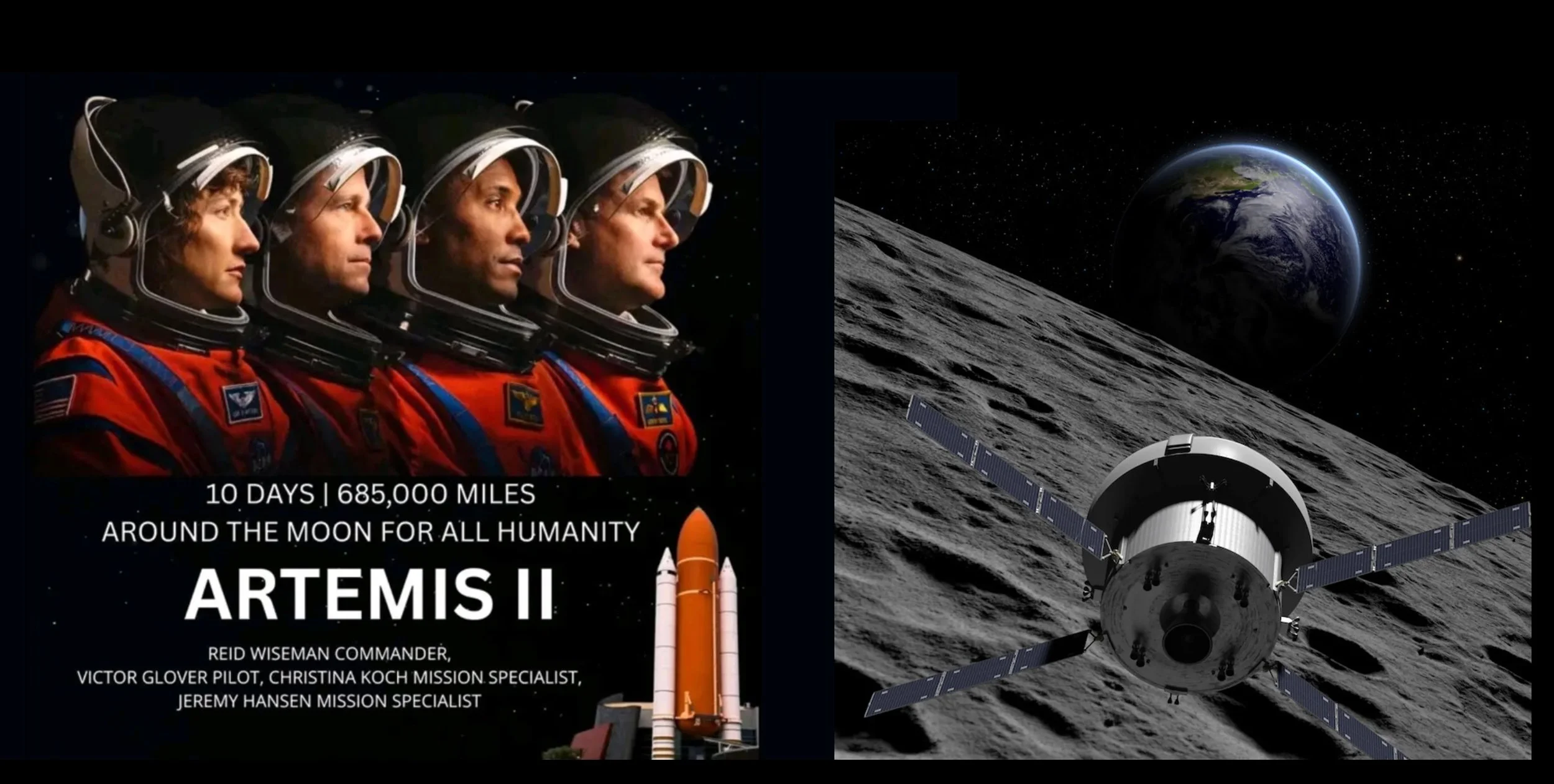
Artemis II crew photo
Artemis II rocket photo:
The Space Launch Systems (SLS) rocket will propel the mission into earth orbit on February 6th (if the weather cooperates). After a few orbits and preparations, the Orion Service Module will leave earth orbit for a 4 day trip to the moon. It will circle the moon one time, and immediately return. The Orion capsule will splashdown in the Pacific Ocean after a 10 day historic journey.
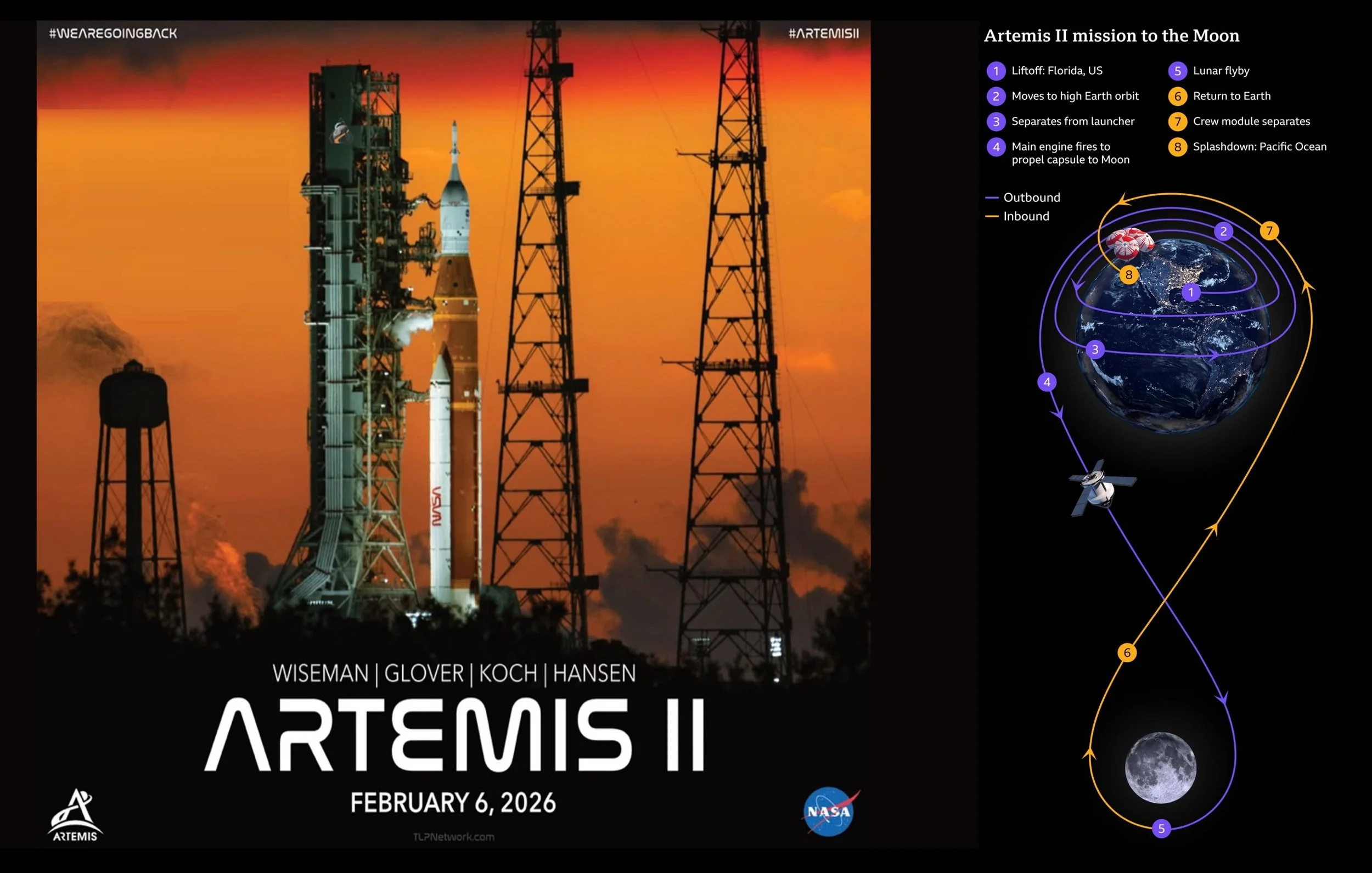
Artemis II rocket photo