What Is a Preschool? How It Differs from Nurseries & Kindergartens, and How to Choose
A nursery where the day unfolds in English, an English-language kindergarten, an international school—amid so many similar-sounding terms, plenty of parents find themselves asking, "What exactly is a preschool in the first place?" As interest in early English education grows, the range of facilities has become more diverse, and simply sorting through the options can feel daunting. This article explains what a preschool fundamentally means, how it differs from Japanese nurseries (hoikuen), kindergartens (yochien) and international schools, typical costs, and the perspectives that help you choose the right school for your child—all grounded in evidence from educational research.
In this article
What is a preschool? The basic definition, made clear
What "preschool" fundamentally means
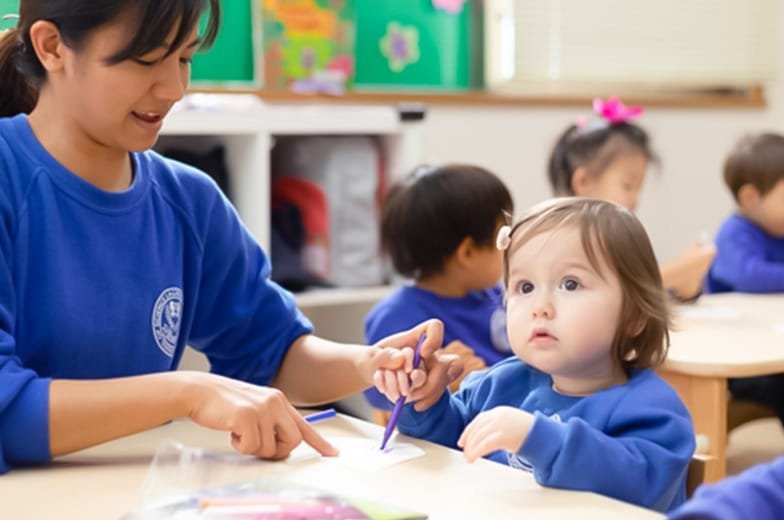
A preschool refers to a facility that provides childcare and education for children who have not yet entered elementary school, using English as the primary language. In Japan it is often understood as "a nursery or kindergarten where the day is spent in English," and its defining feature is that every part of daily life—morning circle, meals, play, arts and crafts—takes place in English. The Japanese preschool market continues to expand: research by Yano Research Institute estimates that the foreign-language school market (including English conversation schools for infants and children, and preschools) reached ¥295.2 billion in fiscal 2024 and is projected to reach ¥350 billion by fiscal 20302.
How "preschool" differs between Japan and the West
In English-speaking countries (the U.S., U.K., Australia, etc.), "preschool" generally refers to a childcare and education institution attended by children aged 3–5, before they start elementary school. In Japan, by contrast, "preschool" has become established as a term for facilities that serve a wide age range from age 0 up to elementary school entry, with the emphasis placed on providing childcare in English. It is worth noting that, even with the same word, the operating model and target ages differ from country to country.
Target ages (18 months to pre-elementary)
Many preschools accept children aged 18 months to 5 years, though some take infants from age 0 and others start from age 3. Whether the environment is well suited to your child's age and developmental stage is the first thing to check when choosing a school.
How a preschool differs from a nursery, a kindergarten, and an international school
The question that most troubles parents considering a preschool is how it differs from a nursery (hoikuen), a kindergarten (yochien) and an international school. Let us take them one at a time.
Preschool vs. nursery (hoikuen)
| Item | Preschool | Licensed nursery |
|---|---|---|
| Primary language | English | Japanese |
| Regulatory status | Mostly unlicensed childcare facilities | Licensed childcare facilities |
| Admission criteria | Based on parents' wishes | In principle, demonstrated need for childcare (e.g. employment) |
| Educational aim | English environment + early childhood education | Childcare + early childhood education |
A nursery is, under the Child Welfare Act, a facility for "households that need childcare because the parents are working or in similar circumstances." A preschool, on the other hand, is in principle open to anyone who wishes to enroll, and is designed around an English environment and educational content.
Preschool vs. kindergarten (yochien)
A kindergarten is an educational institution under the School Education Act, serving children aged 3 and up, with hours that are typically centred on the morning. Preschools, by contrast, are often equipped to care for children for longer hours including extended care, and the English environment is a major point of difference from a kindergarten.
Preschool vs. international school
The two are often confused, but by definition they differ in target age and educational stage. A preschool serves "pre-elementary children," while an international school typically serves "school-age children" from elementary level upward. That said, a growing number of international schools now run an affiliated preschool division, and there are schools where children can move directly on to the kindergarten or elementary division within the same organisation after graduating.
Side-by-side comparison
| Item | Preschool | Nursery | Kindergarten |
|---|---|---|---|
| Primary language | English | Japanese | Japanese |
| Target age | 0–5 | 0–5 | 3–5 |
| Licensing | Mostly unlicensed | Licensed | Licensed |
| Main purpose | English education + childcare | Care + education | Early childhood education |
The abilities a preschool nurtures — what educational research shows
What the "critical period" for bilingual acquisition really is
The "critical period hypothesis," so often cited in discussions of English education, has been examined more carefully in recent research. A review paper from Nanzan University (Shikano, 2018) concludes that the simplistic view of "ages 0–6 as the one and only critical period" is hard to support, and that the sensitive period differs by type of language ability3.
Specifically, multiple studies show that while pronunciation and the ability to distinguish sounds are strongly affected by early exposure, vocabulary and grammar continue to develop well beyond early childhood36. Materials from Japan's Ministry of Education (MEXT) likewise state that in an English-as-a-Foreign-Language (EFL) environment, "no clear critical period has been confirmed"4.
In other words, while there are genuine benefits to encountering English early, the mainstream view in current research is that the continuous volume of input and the quality of the environment—rather than "the earlier the better"—are what ultimately shape a child's bilingual ability36.
The "sensitive period" differs by type of language ability. Pronunciation favours early exposure; vocabulary and grammar keep developing past early childhood. What matters most is the continuous volume of input and the quality of the environment.
The cognitive-development effects of an English environment
The young child's brain changes readily in response to experience, and commentary from the research institute at Ochanomizu University notes that neural circuits reorganise in response to language input5. In an environment like a preschool, where daily life itself unfolds in English, there is an advantage in naturally acquiring elements that are hard to pick up later—such as distinguishing sounds, rhythm and intonation—rather than merely learning vocabulary.
Research from Rikkyo University finds an association between the age at which second-language acquisition begins and speaking fluency, while stopping short of asserting that "acquisition becomes impossible past a certain age"6.
Abilities beyond language (social skills, non-cognitive skills, thinking skills)
The abilities a preschool nurtures are not limited to English proficiency. Everyday interaction in a multicultural setting also fosters "non-cognitive skills" such as social ability, self-esteem and the capacity to collaborate. A study published in the Journal of the Japanese Association of Communication Disorders points to a link between a child's language environment outside the home and their social development, showing how large an impact continuous opportunities for dialogue can have on early childhood development8.
Why combining STEM education matters
A research review of STEM/STEAM education in early childhood concludes that effects can be expected less in the early acquisition of knowledge and more in cultivating a learning disposition, inquiring behaviour and cognitive flexibility10. The cycle of inquiry—"predict → try → compare results → revise"—lays the foundation for understanding cause and effect and for a problem-solving framework.
An approach that combines an English environment with STEM avoids turning language into an end in itself and instead creates a more natural context for language use—"inquiring into something through English." This is a perspective that is easily overlooked when choosing a preschool.
Typical preschool costs and their breakdown
A guide to monthly fees
There are no nationwide public fee statistics for preschools in Japan. The reason is that operating models vary widely—unlicensed childcare facilities, early-learning academies, international-school-affiliated preschools, and so on. Estimates from the market research firm IMARC Group put the size of Japan's preschool market at roughly US$9 billion in 2025, with continued expansion across the industry as a whole1.
In practical terms, fees range from tens of thousands of yen to well over one hundred thousand yen per month, varying greatly depending on whether the programme is half-day or full-day and whether extended care is included.
Enrollment fees, materials, and other costs
Beyond monthly tuition, it is common to also need to pay separately for items such as an enrollment fee (from tens of thousands to hundreds of thousands of yen), materials, meals, event fees and school-bus fees. Because the annual total needs to be calculated as monthly tuition × 12 months plus additional costs, we recommend confirming an estimated annual total in advance when you visit.
Judging "value for the tuition"
Because it is difficult to judge on cost alone, a realistic approach is to evaluate around "what kind of school it is—what it provides." Specifically, weighing four points against the cost—(1) the proportion and quality of English, (2) how systematic the curriculum is, (3) the expertise of the teachers, and (4) the track record of graduates' onward paths—leads to a choice you can feel confident about.
Is preschool pointless? Four perspectives to avoid regret
There is a steady volume of searches such as "preschool pointless" and "preschool regret." These reflect the genuine anxieties parents carry, and they deserve to be addressed honestly.
The main reasons people say it is "pointless"
Behind the claim that it is "pointless" lie three patterns: (1) the English environment was cut off after graduation and the child forgot it; (2) parents became worried about the child's Japanese development; and (3) the results did not feel worth the cost. In every case, these stem less from any problem with preschool itself and more from how the school was chosen and whether continuity was maintained after graduation.
Children for whom it may not be a good fit
To be honest, a preschool is not necessarily the best fit for every child. For a child who finds group life itself highly stressful, or in cases where the family is looking only for a short-term, trial-level experience of English, other options—such as an English conversation class or building an English environment at home—may be a better match.
At the same time, families who feel "I also want my child to attend a Japanese school" or "full-time makes me anxious" can rest assured. At Laurus, you can choose to attend anywhere from 1 to 5 days a week, and combinations are possible—such as a Japanese nursery on weekdays and Laurus on Saturdays only (the Saturday Class). In fact, many children attend while also balancing a Japanese school.
Won't it delay Japanese development? — What the research shows
This is the point parents worry about most, but the research conclusion is clear. A review paper by the Bilingual Science Institute introduces studies in which, for native Japanese-speaking children exposed to English from infancy, Japanese vocabulary was equal to—and in some cases superior to—that of monolingual children (those raised in Japanese only)7. The same paper concludes that "English-environment education in infancy does not delay Japanese vocabulary development"7.
A study published in the Journal of the Japanese Association of Communication Disorders likewise shows that as long as Japanese use at home is secured, bilingual development is entirely possible, and that language development is strongly influenced by environmental factors8. Furthermore, a paper from CODER (an educational research community) examines the effect on English phonological awareness and Japanese development in Japanese preschoolers, and repeatedly points out that Japanese input at home is the key9.
In short, attending an English-environment preschool does not in itself delay Japanese; rather, maintaining the quality and quantity of Japanese at home is the single largest factor in bilingual development. By being deliberate about reading aloud, conversation with family, and age-appropriate Japanese picture books and play, both languages can be nurtured in balance78.
How to picture the path after graduation
The options after graduating from preschool broadly fall into three: (1) advancing to an affiliated kindergarten or international elementary division; (2) advancing to a Japanese kindergarten or elementary school; and (3) transferring to a different international school. Sorting out, before enrollment, which of these three you envision makes it easier to preserve continuity of the English environment after graduation.
How to choose a preschool — a checklist to avoid regret
Check the educational philosophy and curriculum
On the school's website and during your visit, confirm the educational philosophy—"what kind of child they hope to nurture"—and how systematically the curriculum realises that philosophy. Whether the class structure by age, the daily flow, and the yearly curriculum are clearly presented is an indicator of operational transparency.
Assess teacher quality and the proportion of English
The proportion of native teachers, the teachers' educational qualifications (expertise in early childhood education), the ratio of English to Japanese use, and how often teachers turn over all directly affect the stability of your child's language environment. We recommend confirming whether you can observe an actual class during your visit.
Track record of graduates' paths and articulation
Ask "whether internal progression to an affiliated kindergarten is possible" and "what paths graduates have followed." The true value of a preschool is closely tied to the continuity of the English environment after graduation.
The Laurus "Science × English" preschool — as one option
Among the many preschools out there, Laurus International School of Science occupies a distinctive position.
Japan's only Science International Preschool
As Japan's only "Science International Preschool," Laurus provides early education combining science and English for children from 18 months of age11. The classes are named after great scientists—Newton, Galileo, da Vinci, Darwin and Einstein—and the educational philosophy of "nurturing inquirers" runs through every corner of the school12.
Why STEM is incorporated, and what the activities look like
The Laurus curriculum is designed around the cycle of inquiry—"hypothesise → experiment → observe"12. Observing nature across the four seasons outdoors, experiments indoors, and theme-based project learning unfold in stages according to age. Phonics, eurhythmics, Early Math and creative arts are also built in, in a design that develops language, body and thinking in an integrated way.
The daily flow, too, is composed of a concrete rhythm—circle time, discovery time, and afternoon lessons (math, science, life skills)—drawing out children's curiosity as "a place overflowing with 'I want to try that!'"13.
The Laurus pathway after graduation
Children who graduate from the Laurus preschool can advance to the affiliated kindergarten, elementary division, and secondary and high school divisions. In a consistent educational environment built around the Cambridge international curriculum, from 18 months to age 18, they can continue long-term learning with an eye toward university study abroad.
To picture the actual classroom atmosphere and the educators' passion more concretely, we recommend also reading the interview with Mr. Travis Wright, who speaks about early childhood education at Laurus15.
Summary — as one option for expanding your child's possibilities
A preschool is a facility that offers a distinctive option: early childhood education in an English environment. Rather than "starting early automatically confers an advantage," it is continuous input and the quality of the environment that shape your child's bilingual development37.
In choosing a school, it is important to weigh the educational philosophy, the curriculum, the teachers' expertise, and the track record of graduates' paths against your child's characteristics and your family's approach. There is no single right answer in choosing a school. The very process by which you, the parent, discern the environment best suited to your individual child is bound to be a precious time for your family.
At Laurus International School of Science, we hold school visits and trial sessions where you can experience early education combining science and English. For questions about preschool, please also refer to our Preschool FAQ14.
Questions & Answers Frequently Asked Questions
8 questionsA preschool is a facility that provides childcare and education for children who have not yet entered elementary school, using English as the primary language. In an environment where every part of daily life unfolds in English, it aims for natural English acquisition.
A kindergarten (yochien) is a Japanese-environment educational institution under the School Education Act, generally serving children aged 3 and up. The major differences with a preschool are that it operates in an English environment, that its target age range is broad (0–5), and that many facilities are equipped for longer hours of care.
A preschool is a facility for pre-elementary children (roughly 1.5–3 years old), while an international school refers to a school serving a broad age range from early childhood through high school. The two are not in opposition; in many cases they are connected.
Laurus is a consistent international school spanning from preschool to kindergarten and on through the elementary, lower-secondary and upper-secondary divisions. As a result, a child who has built a foundation of English and learning in preschool can move straight on to the higher divisions within the same organisation, without any major change of environment.
It varies by school and operating model, with a common range of tens of thousands to well over one hundred thousand yen per month. Because an enrollment fee, materials, meals and event fees are often required separately, we recommend confirming the annual total when you visit.
It varies by school, but many accept children from 18 months to 2 years old, and some facilities take infants from age 0. Check whether there is a class structure suited to your child's developmental stage.
In research terms, as long as the quality and quantity of Japanese at home are maintained, there is no strong evidence that an English-environment preschool hinders Japanese development7. On the contrary, by being deliberate about reading aloud and conversing in Japanese at home, both languages can be nurtured in balance.
There are mainly three patterns: (1) an affiliated kindergarten or international elementary division; (2) transfer into a Japanese kindergarten or elementary school; and (3) transfer to another international school. Thinking through the direction before enrollment makes it easier to preserve continuity of the English environment.
Three points: the educational philosophy and how systematic the curriculum is; the teachers' expertise and the proportion of English; and the track record of graduates' paths. Rather than deciding on cost alone, we recommend comparing several schools around "what kind of school it is—what it provides."
- Japan Pre-School Market Report — IMARC Group IMARC Group · Market Report
- Survey of the Foreign-Language School Market — Yano Research Institute Yano Research Institute · Market Survey
- A Review of the Critical Period Hypothesis in Second Language Acquisition — Nanzan University (Midori Shikano, 2018) Nanzan University · Academia, Literature & Language
- Materials on the Critical Period in Foreign Language Education — MEXT MEXT · Central Council for Education materials
- The Critical Period of First Language Acquisition and Brain Plasticity — Ochanomizu University IREE Ochanomizu University · Institute for Education Research
- Age of Acquisition and L2 Speaking Fluency — Rikkyo University (Shrosbree, 2024) Rikkyo University · JFLER 2024 Vol.5
- A Review of Early English Education and Japanese Vocabulary Development — Bilingual Science Institute Bilingual Science Institute · Research Review
- Bilingual Development and Social Skills in Linguistic-Minority Preschoolers — Journal of the Japanese Association of Communication Disorders J-STAGE · Peer-reviewed journal article
- English Phonological Awareness and Early English Experience in Japanese Preschoolers — CODER Human Development Research CODER · Human Development Research
- Research on STEAM Education in Early Childhood — Osaka Ohtani University Bulletin (Takitoshi) Osaka Ohtani University · Bulletin paper
- Preschool (official page) — Laurus International School of Science Laurus International School of Science
- Preschool Curriculum — Laurus International School of Science Laurus · Curriculum
- Preschool School Life — Laurus International School of Science Laurus · School Life
- Preschool FAQ — Laurus International School of Science Laurus · FAQ
- What is early childhood education at Laurus? An interview with Mr. Travis Wright — School Highlights Laurus · School Highlights